


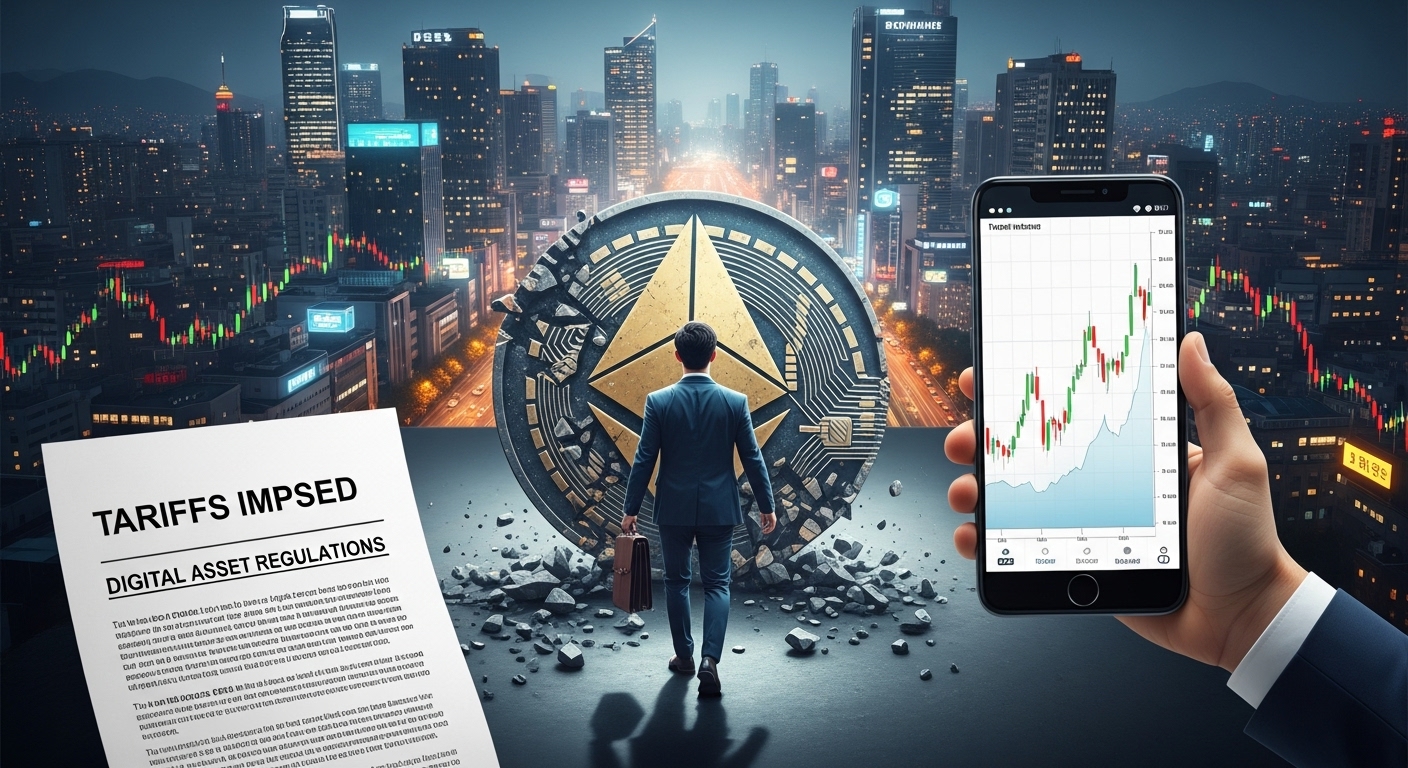
Once among Asia’s most enthusiastic crypto adopters, South Korean retail and institutional investors are now rotating capital out of digital assets and back into domestic equities. The sudden pivot reflects growing unease about global trade tensions, geopolitical risk, and the volatility that continues to define cryptocurrency markets.
For South Korea, a country where crypto trading volumes once rivaled stock market activity, this change is significant. Trump’s aggressive trade rhetoric has reignited fears of protectionism, currency instability, and economic slowdown. As uncertainty rises, South Korean investors abandon crypto in favor of stocks perceived as safer, more regulated, and closely tied to the country’s economic fundamentals.
South Korean Investors Abandon Crypto Amid Global Trade Tensions
The decision by South Korean investors to abandon crypto did not happen in isolation. Trump’s comments on imposing sweeping tariffs on major trading partners sent shockwaves through global markets. For export-driven economies like South Korea, trade instability directly affects corporate earnings, currency valuations, and investor confidence.

Cryptocurrencies, already sensitive to macroeconomic shocks, became less attractive in this environment. Many investors viewed crypto assets as too volatile during periods of heightened geopolitical risk. Stocks, particularly those tied to domestic consumption and government-backed industries, appeared more resilient in comparison.
Why Trump’s Tariff Tirade Triggered a Crypto Exodus
Renewed Fears of Protectionism
Trump’s rhetoric revived memories of previous trade wars that disrupted supply chains and financial markets. As these fears resurfaced, South Korean investors abandon crypto as part of a broader risk-off strategy. Digital assets, often marketed as hedges, failed to provide stability during earlier trade disputes, making investors cautious this time around.
Impact on the Korean Won and Capital Flows
Trade uncertainty often pressures emerging market currencies. A weaker won can amplify crypto volatility for South Korean investors, increasing exposure to exchange rate risk. This dynamic further encouraged investors to shift back into domestic equities, which are perceived as better aligned with local economic conditions.
Crypto Fatigue Among South Korean Retail Investors
South Korea’s crypto boom attracted millions of retail participants, but prolonged volatility has taken its toll. The latest shift suggests that South Korean investors abandon crypto not only because of tariffs, but also due to growing fatigue with unpredictable price swings and regulatory uncertainty.
Many retail traders suffered losses during recent downturns, eroding confidence in the asset class. Stocks, by contrast, offer dividends, earnings visibility, and a clearer regulatory framework. As a result, investors increasingly see equities as a more sustainable long-term option.
Stock Market Gains Renew Investor Confidence
Domestic Equities Regain Appeal
As South Korean investors abandon crypto, domestic stock indices have benefited from renewed inflows. Technology manufacturers, defense contractors, and consumer goods companies have attracted capital as investors reposition portfolios toward sectors expected to weather trade disruptions. Government policies supporting local industries have also bolstered confidence. For many investors, stocks now represent a way to stay invested while reducing exposure to global crypto volatility.
Institutional Investors Lead the Shift
Institutional players have played a key role in this rotation. Pension funds and asset managers, traditionally cautious about crypto, increased stock allocations amid tariff concerns. Their actions reinforced the perception that equities offer relative stability during periods of geopolitical stress.
Regulatory Factors Accelerating the Move Away From Crypto
South Korea’s strict crypto regulations have long shaped investor behavior. Licensing requirements, taxation rules, and enhanced oversight have reduced speculative activity. In this context, South Korean investors abandon crypto more readily when macroeconomic risks rise. Stocks benefit from clearer investor protections and well-established legal frameworks. As regulators emphasize market stability, investors appear more comfortable reallocating funds toward traditional assets.
Crypto vs Stocks During Economic Uncertainty
The trend where South Korean investors abandon crypto mirrors global patterns. During periods of economic uncertainty, investors often retreat from speculative assets. While crypto has matured, it remains highly sensitive to external shocks such as trade wars and political instability. Stocks, especially those tied to essential industries, tend to recover faster from such disruptions. This dynamic explains why South Korean investors are following a familiar global playbook.
Market Data Reflects Changing Sentiment
Trading volumes on South Korean crypto exchanges have declined, while stock market turnover has increased. Analysts note that South Korean investors abandon crypto in favor of equities with stable cash flows and government backing. This shift does not necessarily signal the end of crypto adoption in South Korea, but it highlights how sensitive participation is to macroeconomic signals. When uncertainty rises, investors prioritize capital preservation.
Long-Term Implications for South Korea’s Crypto Market
Temporary Retreat or Structural Shift?
A key question is whether South Korean investors abandon crypto permanently or temporarily. Some analysts argue this is a short-term reaction to tariff fears. Others believe it reflects a deeper reassessment of crypto’s role in diversified portfolios. If global trade tensions persist, crypto markets may continue to struggle for mainstream confidence. However, renewed stability could draw investors back once risk appetite returns.
Innovation Continues Despite Capital Outflows
Despite reduced trading activity, blockchain development in South Korea remains strong. Major corporations and startups continue to invest in decentralized technologies. This suggests that while South Korean investors abandon crypto as an investment, interest in underlying technology endures.
Investor Psychology and Risk Management
Investor psychology plays a major role in asset allocation. Trump’s tariff threats heightened fear, prompting defensive strategies. In this environment, South Korean investors abandon crypto because digital assets amplify emotional responses during market stress. Stocks, with historical data and valuation metrics, offer investors a sense of control. This psychological comfort becomes especially important when headlines drive volatility.
What This Means for Global Crypto Markets
The fact that South Korean investors abandon crypto sends a broader signal to global markets. South Korea has often acted as a bellwether for retail crypto sentiment. A sustained pullback could influence investor behavior in other regions facing similar macroeconomic pressures. However, global crypto markets are diverse. While South Korean participation may dip, other regions could see increased activity depending on local conditions.
Conclusion
The move where South Korean investors abandon crypto underscores how quickly sentiment can change in response to geopolitical shocks. Trump’s tariff tirade reminded markets that political risk remains a powerful force in asset allocation decisions.
For investors, the lesson is clear: diversification and risk awareness are crucial. Stay informed, monitor macroeconomic signals, and closely follow developments where South Korean investors abandon crypto, as these shifts often foreshadow broader market trends.
