


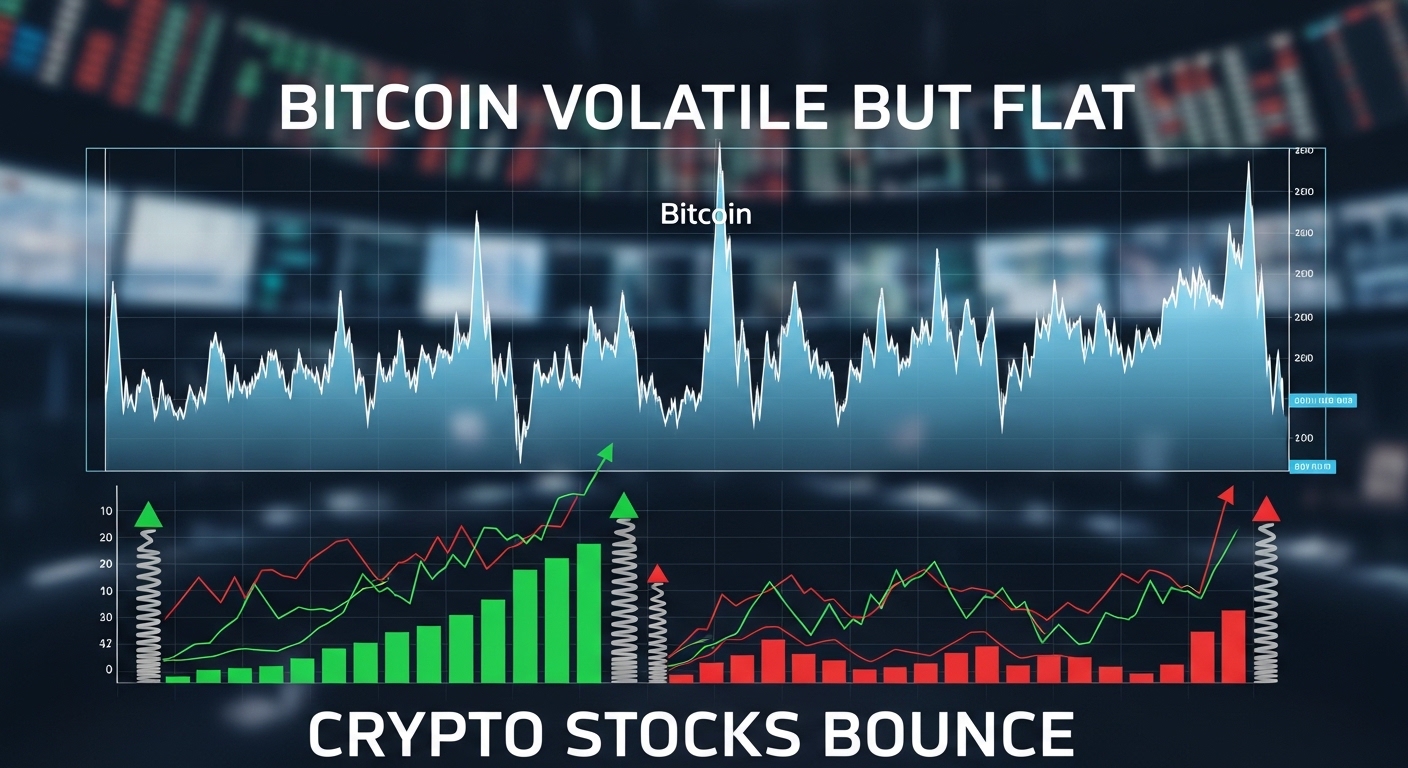
Investors are watching closely as Bitcoin volatile but flat conditions signal indecision. Traders see rapid price spikes and pullbacks, yet the overall weekly movement shows little net change. Meanwhile, publicly traded crypto firms are benefiting from renewed appetite for risk assets, reflecting optimism that AI-related concerns may have been overstated. This unusual setup raises important questions. Why is Bitcoin experiencing volatility without direction? Why are crypto stocks bouncing while the world’s largest cryptocurrency remains range-bound? And what could be the next catalyst that breaks the stalemate? In this in-depth analysis, we explore the dynamics behind the Bitcoin volatile but flat market structure and what it means for investors navigating today’s digital asset landscape.
Bitcoin Volatile but Flat
The phrase Bitcoin volatile but flat captures a market trapped between bullish optimism and cautious restraint. Volatility refers to rapid price movements within short time frames. However, when those swings cancel each other out, the broader trend appears sideways.
Intraday Swings Without Breakout
Bitcoin has been recording sharp hourly fluctuations, often reacting to macroeconomic headlines, ETF flows, and shifts in broader equity markets. Traders see sudden spikes followed by equally quick pullbacks. Yet when zooming out to daily or weekly charts, the price appears stuck within a defined range. This Bitcoin volatile but flat structure often occurs during consolidation phases. After significant rallies or corrections, markets pause as participants reassess positions. Volume typically declines slightly, and momentum indicators hover near neutral levels.
Market Indecision and Liquidity Dynamics
Indecision dominates when neither buyers nor sellers establish clear control. Liquidity plays a major role. If institutional flows remain steady but subdued, Bitcoin may continue oscillating within support and resistance zones. In the current environment, Bitcoin volatile but flat conditions suggest investors are awaiting a catalyst—such as inflation data, Federal Reserve guidance, or large ETF inflows—to determine the next decisive move.
Crypto Stocks Bounce Amid Cooling AI Fears
While Bitcoin consolidates, crypto-related equities are staging a rebound. The key driver? Easing concerns about the sustainability of AI-driven tech valuations.
The Impact of AI Sentiment on Markets
Artificial intelligence has fueled massive rallies in technology stocks. However, recent skepticism about overvaluation sparked volatility across the tech sector. As fears cool and earnings stabilize, investor confidence is returning. This renewed optimism benefits crypto mining companies, blockchain infrastructure firms, and digital asset exchanges. As a result, even though Bitcoin volatile but flat persists, crypto stocks are bouncing strongly.
Why Crypto Equities React Differently
Crypto stocks often act as leveraged plays on Bitcoin. When sentiment improves broadly across tech markets, investors anticipate stronger trading volumes, mining profitability, and blockchain adoption. Therefore, while Bitcoin volatile but flat, equities tied to digital assets may experience amplified gains due to improving risk appetite.
Technical Analysis Behind Bitcoin’s Sideways Volatility
Technical indicators provide insight into why Bitcoin volatile but flat remains the prevailing theme.
Support and Resistance Zones
Bitcoin currently trades within a well-defined range. Support levels attract buyers during dips, while resistance levels trigger profit-taking during rallies. This tug-of-war prevents sustained directional movement. Traders monitor moving averages such as the 50-day and 200-day lines. When price hovers between them, consolidation often follows.
RSI and Momentum Indicators
The Relative Strength Index remains near neutral territory, reinforcing the Bitcoin volatile but flat narrative. Neither overbought nor oversold conditions dominate, reflecting balance between bulls and bears. MACD indicators similarly show limited momentum divergence, suggesting a breakout has yet to gain traction.
Macro Factors Influencing Bitcoin’s Flat Volatility
Broader economic forces heavily influence Bitcoin’s trajectory.

Interest rate speculation impacts liquidity. If investors expect rate cuts, risk assets including Bitcoin typically rally. Conversely, prolonged high rates may suppress upward momentum. The current Bitcoin volatile but flat pattern reflects uncertainty around monetary policy direction.
Inflation and Economic Data
Inflation readings shape investor confidence. Stable or declining inflation may support crypto markets. However, unexpected spikes can renew caution.As markets digest economic data, Bitcoin volatile but flat conditions persist, indicating traders are unwilling to commit heavily before clearer signals emerge.
Institutional Activity and ETF Flows
Institutional participation significantly shapes Bitcoin’s price stability.
Spot Bitcoin ETFs and Market Stability
Spot Bitcoin ETFs have introduced steady inflows, reducing extreme volatility compared to earlier cycles. Even when price swings intraday, institutional demand often absorbs selling pressure.
This dynamic explains why Bitcoin volatile but flat does not necessarily indicate weakness. Instead, it may represent equilibrium between retail speculation and institutional accumulation.
Long-Term Holder Behavior
On-chain data suggests long-term holders are maintaining positions. Reduced exchange reserves indicate limited intent to sell. Such behavior supports consolidation rather than sharp declines.
Comparing Bitcoin to Altcoins During This Phase
Altcoins often react more dramatically during sideways Bitcoin movement.
Capital Rotation Into Smaller Assets
When Bitcoin volatile but flat, traders sometimes rotate capital into altcoins seeking higher short-term returns. This can create mini rallies in Ethereum, Solana, or AI-related tokens. However, such rotations depend on broader sentiment and liquidity availability.
The Role of AI in Crypto Market Sentiment
Artificial intelligence intersects with crypto through blockchain analytics, trading algorithms, and decentralized AI projects. Cooling AI fears have reassured investors that technology valuations may stabilize rather than collapse. This shift supports the rebound in crypto equities even as Bitcoin volatile but flat persists. The relationship between AI and crypto innovation remains strong. Blockchain networks increasingly integrate AI tools for data processing and decentralized applications.
Is a Breakout Imminent?
Consolidation phases rarely last indefinitely.
Bullish Breakout Scenario
If positive catalysts emerge—such as strong ETF inflows or dovish central bank signals—Bitcoin could break above resistance. Volume expansion would confirm renewed bullish momentum.
Bearish Breakdown Risk
Alternatively, negative macro surprises could trigger a breakdown below support. In that case, Bitcoin volatile but flat would transition into directional decline.
Investor Strategy During Volatile but Flat Markets
Navigating sideways volatility requires discipline. Diversification helps mitigate risk during uncertain phases. Investors should monitor macroeconomic indicators, ETF flow data, and on-chain metrics. Patience is essential. Acting impulsively during Bitcoin volatile but flat conditions may lead to unnecessary losses.
Long-Term Outlook for Bitcoin and Crypto Stocks
Despite short-term stagnation, long-term fundamentals remain intact. Bitcoin’s fixed supply and increasing institutional adoption provide structural support. Meanwhile, blockchain innovation and AI integration continue expanding use cases. The coexistence of Bitcoin volatile but flat price action with rebounding crypto stocks reflects market maturation rather than weakness.
Conclusion
The current market phase defined by Bitcoin volatile but flat signals consolidation rather than collapse. While crypto stocks rebound amid cooling AI fears, Bitcoin remains range-bound, awaiting a decisive catalyst.
For investors, this period offers an opportunity to reassess strategy, manage risk, and prepare for potential breakouts. Whether the next move is upward or downward will depend on macroeconomic developments, institutional flows, and broader market sentiment.
See more: Stocks and Bitcoin Sink as Investors Dump Software Shares
