


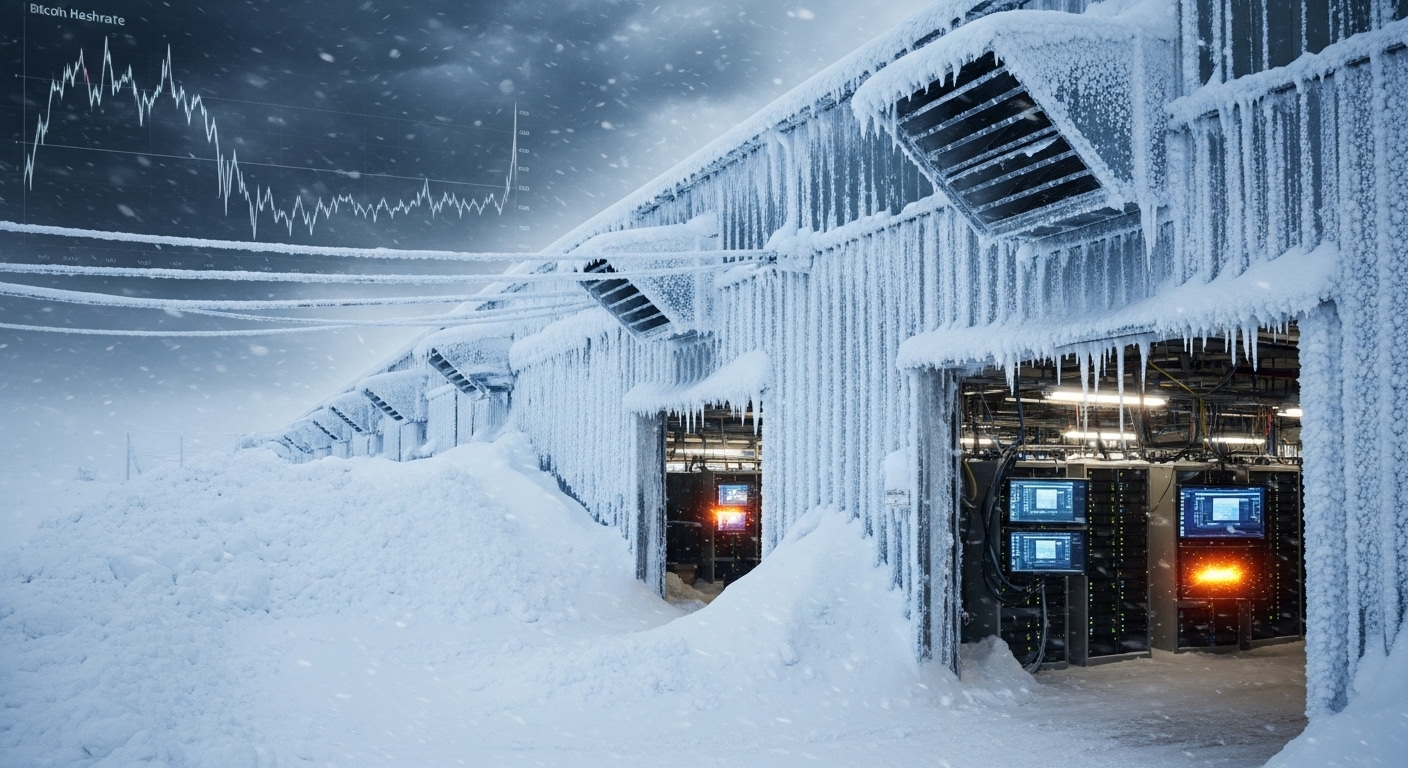
Sub-zero temperatures, snowstorms, and widespread power outages have forced miners offline, disrupted hash rate stability, and reignited debates around infrastructure resilience and energy dependency. For an industry already navigating post-halving pressure and tight margins, the timing could not be worse. As Bitcoin mining hit by severe winter storm headlines dominate crypto news, the impact is being felt far beyond individual mining farms. Network performance, miner revenues, investor sentiment, and even Bitcoin’s short-term price dynamics are all affected when large-scale mining operations are forced to shut down abruptly. This article explores how the winter storm disrupted US Bitcoin mining, why weather events matter more than ever, and what this means for the future of proof-of-work infrastructure.
Bitcoin Mining Hit by Severe Winter Storm: What Happened?
The phrase Bitcoin mining hit by severe winter storm reflects a chain reaction that unfolded across multiple US states. Regions known for high mining concentration, including Texas, Arkansas, North Dakota, and parts of the Midwest, experienced extreme cold, ice accumulation, and grid stress. Power providers issued emergency curtailments to protect residential heating demand, leaving energy-intensive mining operations with no choice but to shut down. Bitcoin miners depend on continuous electricity and stable cooling systems. When temperatures plunge suddenly, equipment faces risks from condensation, frozen components, and abrupt power cycling. Even miners with advanced cold-weather mitigation plans struggled as transmission lines iced over and substations failed. This was not a localized disruption. It was a systemic shock that revealed how deeply Bitcoin mining hit by severe winter storm conditions can ripple through the entire ecosystem.
Why the US Is So Critical to Bitcoin Mining
The Rise of the United States as a Mining Hub
Over the past several years, the US has become the global epicenter of Bitcoin mining. Following China’s mining ban, operators relocated to energy-rich US states, drawn by deregulated power markets and renewable capacity. As a result, when Bitcoin mining hit by severe winter storm events occur in the US, the global network feels the impact almost immediately. Texas alone hosts a significant share of global hash rate. When winter storms disrupt its grid, hash rate declines are often visible within hours. This concentration amplifies weather risk and makes US climate events increasingly relevant to Bitcoin’s global performance.
Weather Dependency and Energy Infrastructure
Mining farms are tightly coupled with local energy infrastructure. While cold weather can reduce cooling costs, extreme winter conditions introduce new risks. Frozen natural gas supplies, downed power lines, and grid frequency instability all contribute to why Bitcoin mining hit by severe winter storm scenarios have become recurring news. As climate volatility increases, miners must adapt to both extreme heat and extreme cold, a dual challenge that strains infrastructure planning.
Immediate Impact on Bitcoin Hash Rate
Network Hash Rate Declines
One of the first indicators when Bitcoin mining hit by severe winter storm conditions occur is a sudden drop in network hash rate. Data following the storm showed a noticeable decline as US-based miners powered down to comply with grid requests or avoid equipment damage. While Bitcoin’s difficulty adjustment mechanism eventually compensates, short-term hash rate drops can affect block times and transaction confirmation speeds. These temporary inefficiencies highlight how dependent the network remains on stable physical infrastructure.
Difficulty Adjustment as a Safety Mechanism
Bitcoin’s protocol is designed to adapt. When hash rate falls, mining difficulty adjusts downward, restoring equilibrium. This mechanism has repeatedly proven effective, even when Bitcoin mining hit by severe winter storm events cause abrupt disruptions. However, frequent weather-induced adjustments introduce volatility for miners, who must plan operations around increasingly unpredictable conditions.
Bitcoin Mining Hit by Severe Winter Storm and Miner Revenue Losses
Forced Shutdowns and Lost Income
When mining rigs go offline, revenue drops to zero instantly. For many operators, even a few days of downtime can erase weeks of profit. As Bitcoin mining hit by severe winter storm disruptions persisted, miners faced lost block rewards and increased operational costs related to restarting equipment. Post-halving economics make this even more painful. With block rewards already reduced, miners rely on continuous uptime to stay profitable. Winter outages compress margins to dangerous levels.
Selling Pressure and Market Effects
To cover fixed costs during downtime, some miners are forced to sell Bitcoin reserves. This behavior, triggered when Bitcoin mining hit by severe winter storm events occur, can increase short-term selling pressure in the market. Although the impact is usually temporary, repeated events can contribute to broader market uncertainty, especially during periods of weak price momentum.
Grid Stability, Curtailment, and Public Scrutiny
Mining and Grid Prioritization
During winter storms, grid operators prioritize residential heating and critical services. Bitcoin mining is often among the first industries asked to curtail load. While many miners participate voluntarily through demand-response programs, critics argue that mining strains energy systems. When Bitcoin mining hit by severe winter storm headlines emerge, public scrutiny intensifies. Policymakers question whether mining operations should be allowed such large energy footprints during emergencies.
The Role of Demand-Response Agreements
Some miners mitigate risk through flexible contracts that allow them to shut down quickly in exchange for lower energy rates. These agreements help stabilize grids but do not eliminate revenue loss. Still, miners with demand-response strategies are better positioned when Bitcoin mining hit by severe winter storm conditions unfold.
Equipment Risks During Extreme Cold
Hardware Damage and Restart Challenges
Cold temperatures pose unique risks to mining hardware. Sudden power loss followed by rapid temperature changes can cause condensation inside ASIC machines. When Bitcoin mining hit by severe winter storm events occur, careful restart procedures are required to prevent permanent damage. Frozen cooling systems and brittle components increase maintenance costs. For large facilities, inspecting and restarting thousands of machines is a slow, expensive process.
Insurance and Operational Preparedness
Some mining companies carry insurance for weather-related disruptions, but coverage varies.

The increasing frequency of events where Bitcoin mining hit by severe winter storm conditions disrupt operations is pushing insurers to reassess risk models and premiums. Preparedness now includes heated enclosures, redundant power systems, and advanced monitoring to reduce downtime.
Broader Implications for Bitcoin Network Security
Does Weather Threaten Bitcoin’s Integrity?
Whenever Bitcoin mining hit by severe winter storm scenarios cause hash rate drops, questions arise about network security. In reality, Bitcoin remains secure due to its global distribution and difficulty adjustment. While US miners play a large role, hash rate is still spread across multiple countries. Short-term disruptions do not compromise the protocol but do highlight the importance of geographic diversification.
Centralization Concerns
The concentration of mining in specific regions increases vulnerability to localized weather events. As Bitcoin mining hit by severe winter storm incidents repeat, the industry may push toward more distributed global mining to reduce systemic risk.
Investor and Market Reactions
How Markets Interpret Weather Disruptions
Investors often view mining disruptions as short-term noise rather than long-term threats. Still, when Bitcoin mining hit by severe winter storm news coincides with broader market weakness, sentiment can turn cautious. Mining stocks, in particular, tend to react negatively due to concerns over lost revenue and higher costs. However, historically, these dips have often been temporary.
Long-Term Confidence in Proof-of-Work
Despite repeated disruptions, confidence in Bitcoin’s proof-of-work model remains strong. Each time Bitcoin mining hit by severe winter storm events test the network, its ability to recover reinforces long-term trust.
Climate Volatility and the Future of Mining
Increasing Frequency of Extreme Weather
Climate data suggests extreme weather events are becoming more common. This trend means Bitcoin mining hit by severe winter storm scenarios may no longer be rare anomalies but recurring challenges. Miners must now plan for both heat waves and polar vortex events, investing heavily in resilience rather than just efficiency.
Innovation Driven by Adversity
Adversity often drives innovation. The repeated reality that Bitcoin mining hit by severe winter storm conditions disrupt operations is accelerating investment in modular data centers, mobile mining units, and smarter grid integration. These innovations could ultimately make mining more robust and adaptable.
What This Means for Policymakers and the Public
As Bitcoin mining hit by severe winter storm events draw media attention, policymakers face renewed pressure to regulate mining energy usage. At the same time, miners argue that their ability to curtail load actually supports grid stability during emergencies. This tension will shape future regulation, particularly in energy-sensitive states.
The Road Ahead for US Bitcoin Miners
US miners remain committed to growth, but resilience is now the priority. Weather-proofing infrastructure, diversifying locations, and improving energy flexibility are no longer optional. As Bitcoin mining hit by severe winter storm incidents continue, only the most adaptable operators will thrive.
Conclusion
The latest event where Bitcoin mining hit by severe winter storm conditions disrupted operations serves as a powerful reminder that Bitcoin is both digital and physical. While the protocol is decentralized and resilient, its infrastructure exists in the real world, subject to climate, grids, and geography. These disruptions are painful, but they also strengthen the system over time by forcing innovation, efficiency, and smarter design. If you want to understand where Bitcoin mining is headed next, keep following how Bitcoin mining hit by severe winter storm events reshape the industry and push it toward a more resilient future.
