


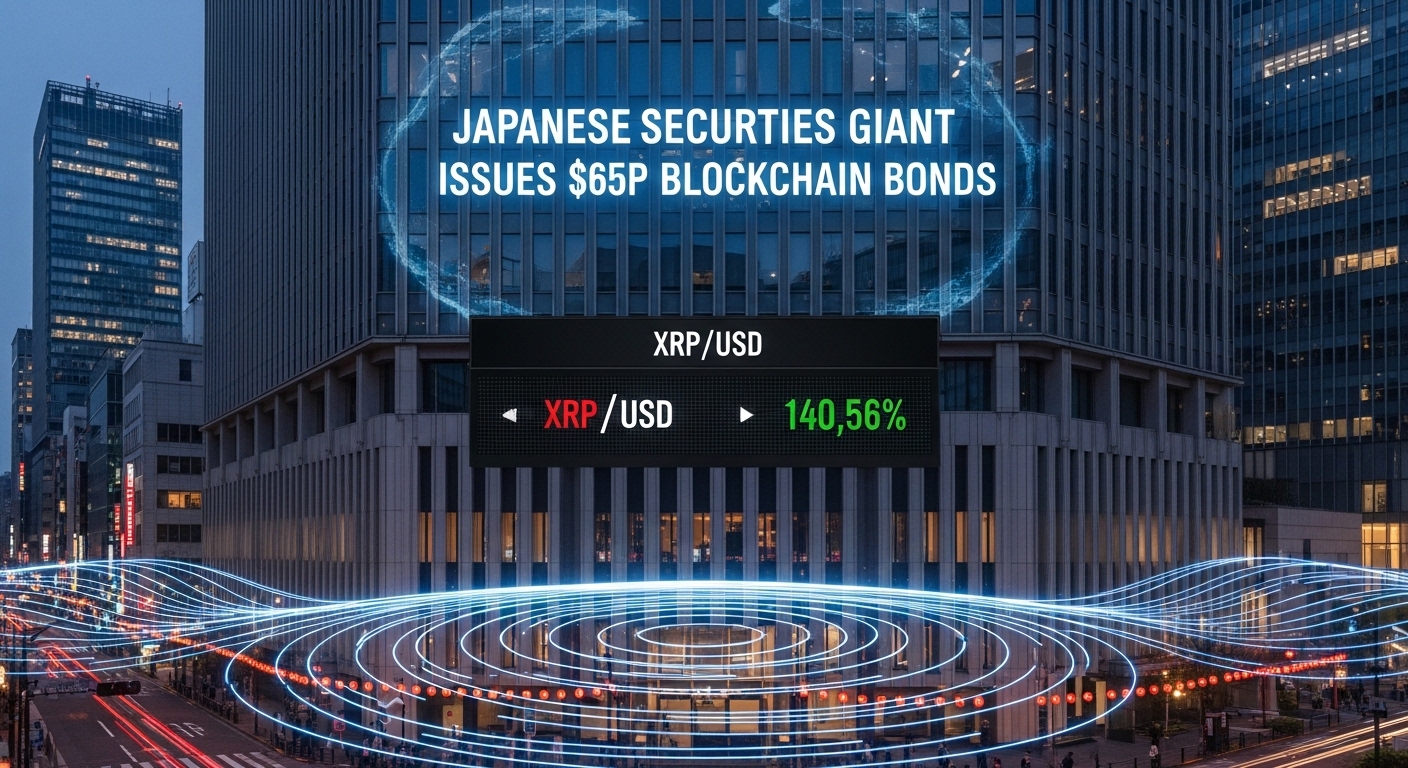
Japan has long been considered one of the most progressive markets for digital asset regulation. Now, with a $65 million XRP-paying blockchain bond issuance, the country reinforces its leadership in tokenization and financial innovation. Investors and analysts are watching closely as blockchain bonds increasingly emerge as a viable alternative to traditional debt instruments. This development could redefine how securities are issued, settled, and managed globally.
Japanese Securities Giant to Issue $65 Million XRP-Paying Blockchain Bonds: A Market First
The news that a Japanese securities giant to issue $65 million XRP-paying blockchain bonds marks a milestone in the evolution of tokenized finance. The securities firm behind the initiative, SBI Holdings, has consistently demonstrated interest in blockchain and digital assets. SBI Holdings is closely affiliated with Ripple Labs, the company behind the XRP Ledger. XRP, the native token of the ledger, has been widely adopted for cross-border payment solutions. By incorporating XRP into bond payouts, the issuance introduces programmable finance into debt markets. Unlike conventional bonds that pay interest in fiat currency, these blockchain bonds distribute returns in XRP. This innovation enhances transparency, accelerates settlement, and potentially reduces operational costs.
XRP-Paying Blockchain Bonds
To appreciate why a Japanese securities giant to issue $65 million XRP-paying blockchain bonds is so significant, it’s essential to understand how blockchain bonds function.
Blockchain bonds are digital debt instruments recorded and managed on distributed ledger technology. Instead of relying on centralized clearinghouses, ownership and transactions are verified through blockchain consensus mechanisms. In this case, interest payments and possibly principal repayments are denominated in XRP. XRP Ledger offers fast transaction speeds and low fees, making it suitable for institutional use. Tokenized bonds can streamline issuance processes, automate coupon payments through smart contracts, and provide near-instant settlement compared to traditional systems.
Why Japan Leads in Blockchain Securities Innovation
Japan has cultivated a regulatory environment supportive of digital assets. The country was among the first to recognize cryptocurrencies as legal property under financial law. This clarity has encouraged institutions like SBI Holdings to experiment confidently. By enabling a $65 million XRP-paying blockchain bond issuance, Japan demonstrates how established financial players can adopt blockchain infrastructure responsibly. Japanese regulators have balanced innovation with investor protection, creating a stable environment for tokenized securities to flourish.
The Strategic Role of XRP in Bond Payments
The integration of XRP into bond structures is not arbitrary. XRP was designed for efficient cross-border transfers, offering settlement within seconds and minimal transaction costs. For institutional bonds, these features translate into operational efficiency. Payments that previously required intermediaries and multi-day clearing can occur almost instantly on the blockchain. The decision that a Japanese securities giant to issue $65 million XRP-paying blockchain bonds may also strengthen XRP’s position as an enterprise-focused digital asset. Investors receiving XRP payouts gain exposure to cryptocurrency markets, blending traditional fixed-income returns with digital asset potential.
Institutional Tokenization Gains Momentum
Tokenization has become a central theme in global finance. Major banks and asset managers are exploring digital bonds, tokenized funds, and blockchain-based securities. When a Japanese securities giant to issue $65 million XRP-paying blockchain bonds, it reinforces the credibility of tokenized assets. Institutional adoption reduces skepticism and signals maturity in blockchain infrastructure. Across Europe and Asia, financial institutions are piloting blockchain-based issuance platforms. The move by SBI Holdings could accelerate adoption in other jurisdictions.
Benefits of Blockchain Bonds for Investors
Blockchain bonds offer numerous advantages. Transparency improves as transactions are recorded immutably. Administrative costs decrease due to automation. Investors benefit from faster settlement, lower fees, and potentially enhanced liquidity through digital marketplaces. The XRP-paying blockchain bonds model adds an additional layer of innovation. Instead of receiving fiat currency, investors obtain digital tokens that can be traded, held, or converted. This flexibility could attract a new generation of tech-savvy investors seeking hybrid exposure to fixed-income and cryptocurrency markets.
Regulatory and Compliance Considerations
Any initiative involving digital assets must align with regulatory standards. Japan’s Financial Services Agency maintains strict oversight of securities issuance.

The fact that a Japanese securities giant to issue $65 million XRP-paying blockchain bonds under regulatory supervision indicates growing confidence in blockchain compliance frameworks. Smart contracts embedded within the bond structure can automate KYC and AML checks. This enhances security and reduces fraud risks. Clear regulations also reassure institutional investors wary of legal ambiguity.
Market Impact on XRP and Digital Assets
The announcement has potential implications for XRP’s market performance. Institutional utility often strengthens investor sentiment. While cryptocurrency prices fluctuate, increased real-world applications contribute to long-term value propositions. By linking XRP directly to bond coupon payments, the issuance integrates the token into mainstream finance rather than speculative trading alone. This could influence how investors perceive digital assets within diversified portfolios.
The Future of Tokenized Bonds in Asia
Asia has become a hub for blockchain experimentation. Financial centers in Tokyo, Singapore, and Hong Kong compete to attract fintech innovation. The move that a Japanese securities giant to issue $65 million XRP-paying blockchain bonds could spark regional competition. Other securities firms may explore similar models using blockchain platforms. Tokenized bonds may soon coexist alongside traditional debt instruments, offering investors diversified options.
Broader Implications for Global Capital Markets
Blockchain integration into bond markets represents a structural shift. Capital markets rely heavily on intermediaries, custodians, and clearing systems. Distributed ledger technology simplifies these layers, enabling direct settlement between issuers and investors. If successful, the $65 million XRP-paying blockchain bond issuance could pave the way for larger offerings and cross-border blockchain securities. Institutional investors increasingly seek efficiency, transparency, and innovation. Blockchain bonds align with these objectives.
Technological Infrastructure Behind the Issuance
The XRP Ledger plays a critical role in enabling fast and cost-effective transactions. Its consensus mechanism differs from proof-of-work systems, reducing energy consumption and enhancing scalability. Smart contracts or programmable features can automate bond lifecycle management, including interest calculations and redemptions. This automation reduces manual intervention and operational risk.
Risks and Challenges
Despite the optimism, challenges remain. Cryptocurrency volatility introduces additional risk for investors receiving XRP payments. Market fluctuations could impact the real value of coupon distributions. Regulatory changes in global markets may also affect cross-border participation. Nevertheless, innovation often begins with calculated experimentation.
Conclusion
The decision that a Japanese securities giant to issue $65 million XRP-paying blockchain bonds marks a transformative moment for both traditional finance and cryptocurrency markets. By combining tokenized securities with XRP-based payments, this initiative bridges two financial worlds. It demonstrates that blockchain technology is not merely experimental but increasingly integral to institutional innovation.
See more: Bitcoin Drops to Four-Month Low Amid Market Uncertainty
