


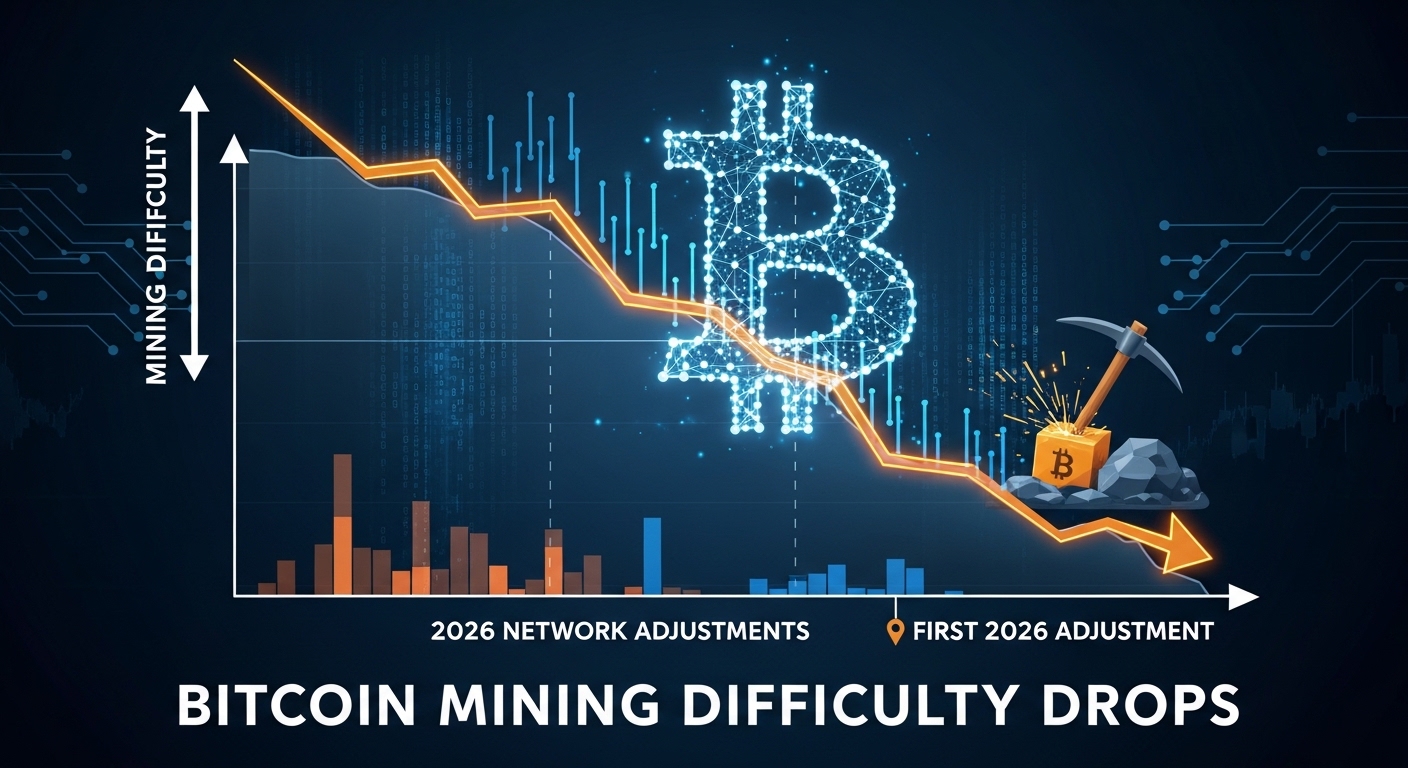
Difficulty adjustments are a core feature of Bitcoin’s design, but when they occur after prolonged pressure on miners, they often reveal deeper changes in network dynamics, profitability, and sentiment. As Bitcoin mining difficulty drops, it signals that some miners have exited the network, reducing overall hash rate and prompting the protocol to rebalance block production. For miners still operating, this adjustment can provide temporary relief by lowering the computational effort required to mine new blocks. For investors and analysts, it offers valuable insight into the health of the mining sector and the broader Bitcoin ecosystem. Understanding why Bitcoin mining difficulty drops, what triggered this first 2026 update, and how it could influence Bitcoin’s price and network security is essential for anyone tracking the evolution of the world’s largest cryptocurrency.
Bitcoin Mining Difficulty Drops: Understanding the 2026 Adjustment
What Bitcoin Mining Difficulty Really Means
Bitcoin mining difficulty is a measure of how hard it is to mine a new block on the Bitcoin blockchain. It adjusts approximately every two weeks to ensure that blocks are produced roughly every ten minutes, regardless of changes in hash rate. When Bitcoin mining difficulty drops, it means the network has detected a decline in total computational power. This adjustment ensures that remaining miners can still find blocks at a predictable pace, preserving Bitcoin’s reliability and security. The first difficulty drop of 2026 suggests that mining conditions toward the end of 2025 and early 2026 became increasingly challenging, forcing some operators to shut down or reduce capacity.
Why This Drop Matters
This adjustment is not just a technical update. When Bitcoin mining difficulty drops, it often reflects financial stress among miners, changes in energy costs, or shifts in Bitcoin’s market price. Each of these factors can influence broader market behavior. Historically, difficulty drops have coincided with periods of miner capitulation, consolidation, or the early stages of recovery following prolonged downturns.
Why Bitcoin Mining Difficulty Drops After Periods of Miner Stress
Rising Costs and Shrinking Margins
One of the primary reasons Bitcoin mining difficulty drops is sustained pressure on miner profitability. Electricity prices, hardware depreciation, and maintenance costs continue to rise, while Bitcoin price growth does not always keep pace.
When revenue fails to cover expenses, less efficient miners are forced offline. As these miners exit, the total hash rate declines, triggering a downward difficulty adjustment.
Impact of Bitcoin Price Volatility
Bitcoin’s price volatility plays a direct role in determining whether Bitcoin mining difficulty drops. Sharp price corrections can instantly reduce mining revenue, making operations unviable for high-cost miners.
The first 2026 difficulty drop suggests that recent price action may not have supported the current scale of mining activity, prompting the network to rebalance.
Bitcoin Mining Difficulty Drops and Hash Rate Dynamics
Hash Rate Decline Explained
Hash rate represents the total computational power securing the Bitcoin network. When Bitcoin mining difficulty drops, it usually follows a noticeable decline in hash rate as miners shut down machines or exit entirely. This does not necessarily indicate a long-term weakening of the network. Instead, it reflects a transitional phase where inefficient operations are filtered out.
Network Resilience Despite Lower Difficulty
Even as Bitcoin mining difficulty drops, the network remains secure. Bitcoin’s decentralized structure and automatic difficulty adjustment ensure continuity, even during periods of reduced participation. Historically, hash rate often rebounds after difficulty drops as remaining miners expand operations under more favorable conditions.
Bitcoin Mining Difficulty Drops and Miner Profitability
Relief for Remaining Miners
When Bitcoin mining difficulty drops, miners who stay online benefit from lower competition. Each unit of hash power has a slightly higher chance of earning block rewards, improving profitability margins. This relief can stabilize the mining ecosystem, allowing stronger players to consolidate and prepare for future expansion.
Short-Term Gains vs Long-Term Sustainability
While a difficulty drop can boost short-term profitability, it does not solve underlying structural issues. Energy efficiency, hardware innovation, and regulatory clarity remain critical for long-term mining sustainability. Understanding why Bitcoin mining difficulty drops helps miners make informed decisions about scaling, upgrading equipment, or relocating operations.
Bitcoin Mining Difficulty Drops and Market Sentiment
How Investors Interpret Difficulty Adjustments
For investors, the fact that Bitcoin mining difficulty drops can be interpreted in different ways. Some view it as a bearish signal, suggesting reduced confidence or declining participation. Others see it as a necessary reset that removes excess leverage from the system. Historically, difficulty drops have often occurred near periods of market pessimism, when sentiment is already fragile.
Psychological Impact on the Crypto Market
News that Bitcoin mining difficulty drops can influence sentiment beyond miners alone.

Traders may interpret it as a sign of capitulation, while long-term holders may see it as confirmation that the network is adapting as designed. This divergence in perception contributes to volatility around difficulty adjustment periods.
Bitcoin Mining Difficulty Drops and Network Security
Does Lower Difficulty Mean Lower Security?
A common misconception is that when Bitcoin mining difficulty drops, network security is compromised. In reality, security depends on total hash rate, not difficulty alone. While a declining hash rate can temporarily reduce the cost of attacking the network, Bitcoin’s scale and decentralization still make such attacks economically impractical.
Self-Correcting Mechanisms at Work
Bitcoin’s protocol is designed to respond dynamically when Bitcoin mining difficulty drops. By adjusting difficulty, the network maintains block timing and incentivizes miners to continue participating. This built-in resilience is one of the reasons Bitcoin has operated continuously for over a decade.
Historical Patterns When Bitcoin Mining Difficulty Drops
Looking back at previous cycles, moments when Bitcoin mining difficulty drops have often aligned with transitional phases in the market. In several instances, these drops occurred shortly before price stabilization or gradual recovery. While not a precise timing tool, difficulty adjustments provide valuable context when analyzing broader market conditions. Understanding historical patterns helps investors avoid overreacting to short-term changes and focus on long-term fundamentals.
Bitcoin Mining Difficulty Drops in the Context of 2026
Macro Factors Influencing Mining
The first 2026 adjustment where Bitcoin mining difficulty drops does not exist in isolation. Global energy markets, regulatory developments, and macroeconomic conditions all influence mining economics.
Uncertainty around energy prices and tighter financial conditions may have contributed to recent miner exits.
Technological Shifts in Mining Hardware
As Bitcoin mining difficulty drops, it also highlights the ongoing evolution of mining hardware. More efficient machines continue to replace older models, reshaping the competitive landscape. This transition phase often coincides with difficulty adjustments as the network adapts to changing efficiency levels.
Bitcoin Mining Difficulty Drops and Bitcoin Price Outlook
Correlation With Price Movements
While there is no direct causal link, periods when Bitcoin mining difficulty drops have often occurred during price consolidation or after significant declines. Once selling pressure from miners subsides and difficulty stabilizes, price action can become more constructive.
What Traders Should Watch Next
Following a difficulty drop, traders often monitor hash rate recovery, miner reserves, and on-chain activity. These indicators help determine whether the market is stabilizing or facing further downside. Understanding why Bitcoin mining difficulty drops provides critical context for interpreting these signals.
Conclusion
The moment when Bitcoin mining difficulty drops in the first 2026 update is a reminder of how adaptive and resilient the Bitcoin network truly is. While the adjustment reflects recent stress within the mining sector, it also demonstrates the protocol’s ability to rebalance and maintain stability under changing conditions. For miners, this difficulty drop offers short-term relief and an opportunity to reassess operations. For investors, it provides a valuable signal about network health, sentiment, and potential market inflection points.
See more: Bitcoin Mining Difficulty Drops Relief for Struggling Miners
