


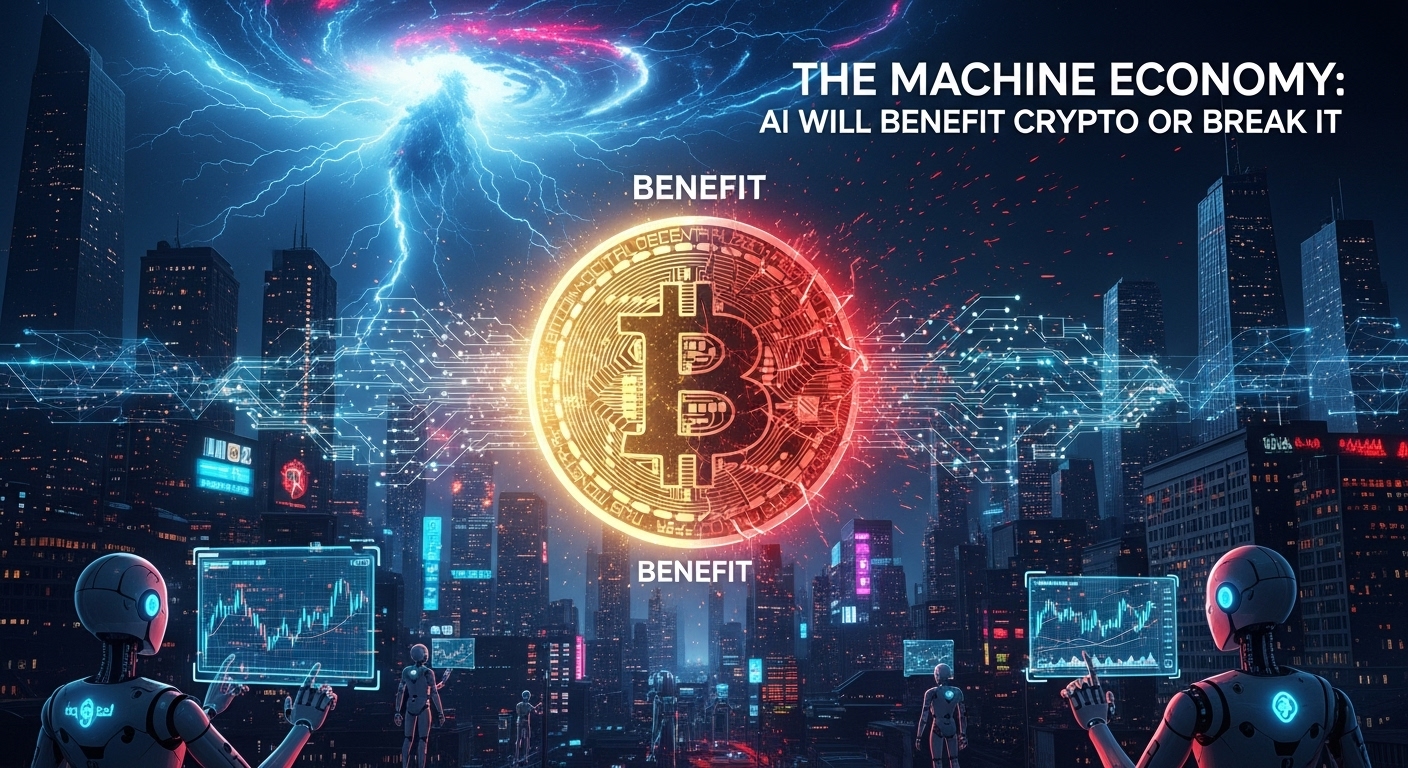
At the heart of this transformation lies a crucial question: will crypto serve as the financial backbone of this machine-driven future, or will AI render decentralized systems obsolete? The convergence of AI and blockchain, once a speculative concept, is now becoming a tangible force reshaping finance, data ownership, and digital trust. As algorithms grow more autonomous and intelligent, they require native, programmable money systems capable of operating at machine speed. Crypto appears uniquely suited for this role, yet the same intelligence that empowers automation could also centralize power and undermine decentralization.
The Machine Economy in the Age of AI
The machine economy refers to an ecosystem where machines act as independent economic agents. These agents can earn, spend, invest, and allocate resources using digital currencies. In this context, the machine economy AI will benefit crypto by creating demand for trustless, borderless, and programmable financial systems.
AI-driven machines generate and consume data continuously. They optimize logistics, manage energy grids, and power decentralized applications. For these systems to function efficiently, they require frictionless payment rails and transparent settlement layers. Traditional banking infrastructure struggles to meet these demands due to latency, regulatory complexity, and geographic constraints.
Cryptocurrency, powered by blockchain technology, offers a potential solution. Smart contracts, tokenized incentives, and decentralized finance protocols align naturally with AI-driven automation. However, the relationship is not guaranteed to be symbiotic. The same AI capabilities that enhance efficiency could also consolidate control in the hands of a few dominant platforms.
The Machine Economy AI Will Benefit Crypto Through Automation
AI as a Catalyst for On-Chain Activity
One of the strongest arguments that the machine economy AI will benefit crypto lies in automation. AI systems excel at executing predefined logic at scale, making them ideal users of smart contracts. Automated market makers, decentralized exchanges, and lending protocols already rely on algorithmic decision-making.
As AI agents begin interacting directly with blockchain networks, transaction volume and network utility could increase dramatically. Machines paying machines for data, computation, or energy creates a self-sustaining economic loop that operates independently of human oversight. This machine-to-machine commerce elevates crypto from a speculative asset to a functional medium of exchange embedded in digital infrastructure.
Smart Contracts and Autonomous Decision-Making
Smart contracts enable AI systems to execute agreements without intermediaries. These contracts reduce friction, enforce rules transparently, and minimize counterparty risk. In a machine economy, AI-driven agents could dynamically adjust contract terms based on real-time data, market conditions, or performance metrics. This synergy strengthens the case that the machine economy AI will benefit crypto, particularly in sectors like supply chain management, decentralized cloud computing, and data marketplaces.
Where AI Could Break Crypto Instead
Centralization Risks in an AI-Dominated Economy
While AI can enhance efficiency, it also tends to favor scale. Large models require massive datasets and computational resources, often controlled by centralized entities. If these entities dominate AI infrastructure, they could exert disproportionate influence over blockchain networks.
In such a scenario, the machine economy AI will benefit crypto becomes a fragile assumption. Centralized AI platforms could bypass decentralized systems altogether, creating proprietary payment rails and closed ecosystems that undermine open networks. This risk challenges crypto’s core value proposition of decentralization and censorship resistance.
Algorithmic Exploitation and Market Manipulation AI-driven manipulation, crypto adoption could suffer. Regulatory scrutiny would intensify, potentially restricting innovation and accessibility.
The Role of Decentralized AI in Preserving Crypto’s Promise
Open-Source Models and Distributed Compute
To ensure that the machine economy AI will benefit crypto, decentralization must extend beyond finance into AI itself. Decentralized AI initiatives aim to distribute model training, inference, and governance across networks rather than central servers.
Blockchain-based incentives can reward participants for contributing data, computation, and model improvements. This approach aligns economic incentives with transparency and fairness, preserving crypto’s foundational principles.
Data Ownership and Tokenized Incentives
AI thrives on data, but data ownership remains contentious. Blockchain enables verifiable data ownership and monetization through tokenized incentives. Individuals and organizations can contribute data to AI models while retaining control and earning rewards. This model strengthens the argument that the machine economy AI will benefit crypto by embedding value exchange directly into data-driven ecosystems.
Crypto as the Native Currency of Machines
Why Traditional Finance Falls Short
Traditional financial systems were designed for human interaction, not machine autonomy. Settlement delays, identity requirements, and jurisdictional barriers hinder machine-to-machine commerce. Crypto offers programmable money that operates continuously, globally, and without permission. For AI agents operating at scale, these characteristics are not optional; they are essential. As the machine economy expands, demand for such financial primitives could surge, reinforcing crypto’s relevance.
Micropayments and High-Frequency Transactions
AI-driven systems often rely on micropayments, paying fractions of a cent for data queries, API calls, or computational tasks. Blockchain networks optimized for scalability and low fees are uniquely positioned to support this activity. This transactional intensity supports the thesis that the machine economy AI will benefit crypto by embedding it deeply into digital operations.
Regulatory and Ethical Challenges Ahead
Governance in a Machine-Driven World
As AI agents gain economic agency, questions of accountability and governance arise. Who is responsible when an autonomous system causes financial harm? How are disputes resolved in decentralized environments? Blockchain governance mechanisms, such as decentralized autonomous organizations, offer potential frameworks for addressing these challenges. However, their effectiveness remains untested at machine scale.
Balancing Innovation and Oversight
Regulators face the challenge of fostering innovation without enabling systemic risk. Excessive regulation could stifle the very experimentation needed to realize the benefits of the machine economy. Insufficient oversight could lead to exploitation and instability. The outcome of this balance will influence whether the machine economy AI will benefit crypto or constrain its growth.
The Future Outlook: Symbiosis or Collision
The relationship between AI and crypto is not predetermined. It will be shaped by design choices, governance models, and collective priorities. If decentralization remains a guiding principle, AI could amplify crypto’s strengths and unlock unprecedented economic coordination.
If efficiency and control dominate instead, crypto risks becoming a niche tool overshadowed by centralized machine economies. This tension defines the debate around the machine economy AI will benefit crypto, making it one of the most consequential questions in technology today.
Conclusion
The machine economy is no longer a distant concept; it is unfolding in real time. Whether the machine economy AI will benefit crypto or break it depends on how developers, investors, regulators, and users shape the systems being built today. Crypto has the potential to become the native financial layer of autonomous machines, enabling trustless, global, and programmable value exchange. To realize this vision, decentralization must extend beyond finance into AI itself.
Now is the moment to engage, experiment, and influence the outcome. If you care about the future of money, technology, and autonomy, it is time to follow and participate in the conversation around the machine economy AI will benefit crypto before the machines decide for us.
See mare: Bitcoin Trading Price Alerts Complete Guide to Automated Crypto Notifications 2025
